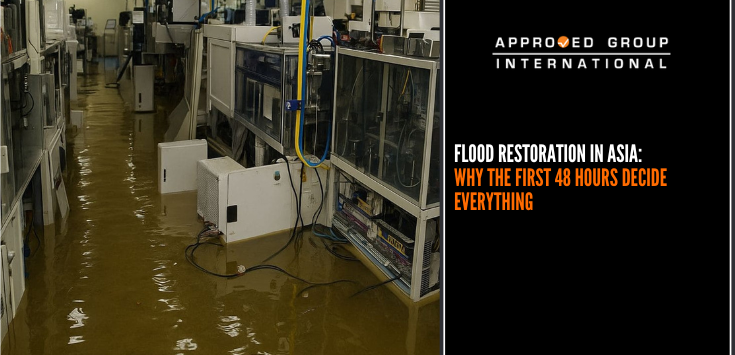
When a flood hits an industrial facility, most people look at the water and assume the water is the problem.
But after decades of responding to monsoon-season disasters across Malaysia, Singapore, Vietnam, Indonesia, and the Philippines, we’ve learned something very different:
A facility that could be 90% restorable on Day 1 can easily become a total loss by Day 7 — even if the water has already receded.
This article explains why this happens, what insurers and loss adjusters must do, and critically, what factory and building owners must do immediately to prevent avoidable multimillion-dollar losses.
When floodwater enters a facility, most teams instinctively request “restoration.”
Search terms typically include:
But restoration is NOT the first step.
There is a phase before it — a phase that determines whether restoration is even possible.
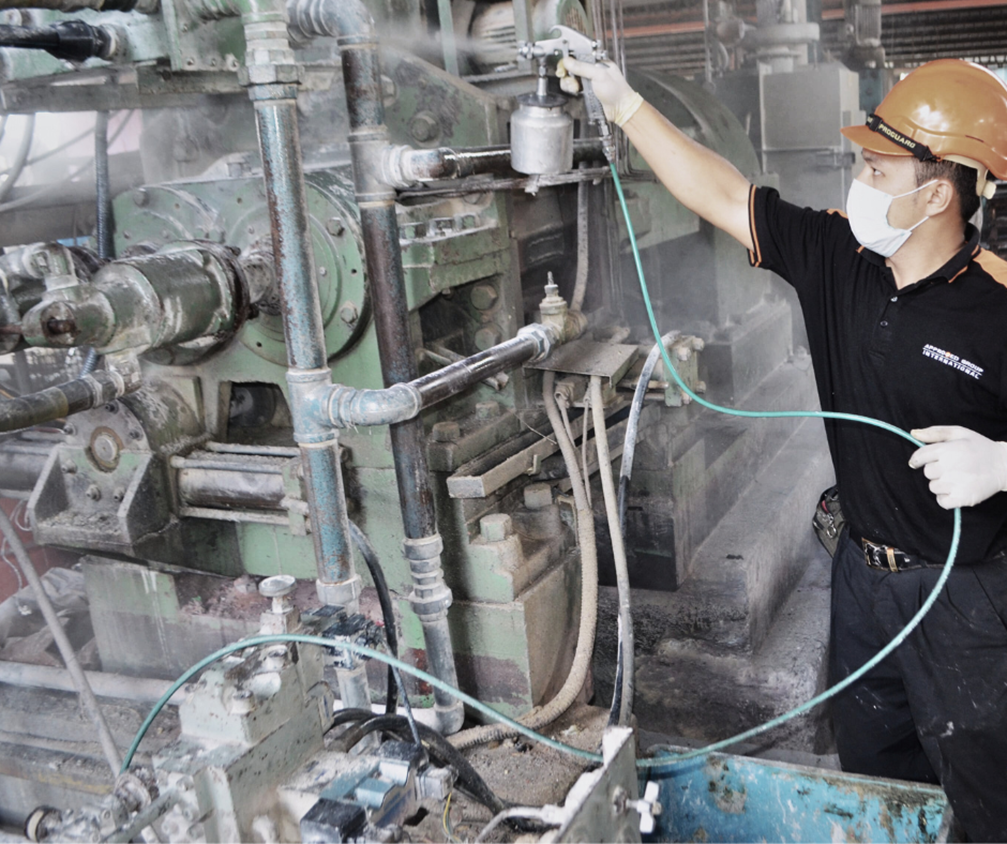
Stabilisation is the urgent, science-driven phase that stops corrosion, humidity spikes, and chemical reactions before they become irreversible.
It includes:
In simple terms, stabilisation buys time.
And time is the one thing flood losses do not give generously.
A predictable timeline we see across Asia:
Day 1: Machinery is restorable
Day 3–4: Micro-corrosion begins on connectors and printed circuit boards
Day 5: Bearings seize, boards delaminate, motors lock
Day 7+: Equipment becomes uneconomical to restore
This pattern repeats almost every monsoon season — and it is completely preventable with immediate stabilisation.
Floodwater — especially in Asia — is rarely “clean.”
It often contains:
When water meets oxygen + salts + exposed metals, corrosion accelerates exponentially.
This is especially destructive for:
Even high-value electronics can become a total loss within days without stabilisation.

These examples reflect common patterns we see across the region, while keeping all client identities confidential.
Outcome: USD 3–4 million saved
A Penang factory flooded overnight due to a sudden monsoon surge.
At first glance, it looked manageable — most machines were above the waterline.
But by Day 2, humidity readings exceeded safe thresholds.
By Day 4, micro-corrosion had started forming on connectors.
If stabilisation had been delayed, the entire SMT line would have been a total loss.
AGI deployed a stabilisation team within 48 hours, preserving over 80% of the equipment and keeping downtime to a minimum.
Risk Window: 24–48 hours
Saltwater ingress is one of the most dangerous forms of contamination in Singapore’s coastal sites.
Floodwater left a thin, conductive film on copper wiring and switchgear — invisible to the naked eye but highly destructive.
Early stabilisation prevented:
Without fast action, the replacement cost would have exceeded SGD 10 million.
Large industrial halls in Indonesia trap moisture long after floods vanish.
In this case, trapped humidity caused oxidation to accelerate rapidly.
AGI established pressure-controlled zones and humidity management systems, preventing large-scale mechanical failure that would have occurred by Day 6.
Typhoon-driven floodwater carries extremely high contaminant loads.
Motors, control panels, and conveyors were coated in conductive residues within hours.
AGI stabilised the facility within 48 hours, protecting electrical components and restoring 70% of the equipment.
Cleanrooms are extremely vulnerable to humidity breaches.
In this case, corrosion started forming within hours, not days.
By acting immediately, AGI restored the SMT lines and prevented a multimillion-dollar total loss.

Our data across more than 30 years is consistent:
Within 48 Hours
After 72–96 Hours
After Day 7
Most facilities reach total loss status.
Full replacement is often the only option left.
This is why industrial floods demand immediate stabilisation, not delayed decision-making.
WHAT INSURERS AND LOSS ADJUSTERS MUST DO IMMEDIATELY AFTER A FLOOD
Here is the workflow used by major insurers across Asia:
Step 1 — Approve Stabilisation Immediately
This should begin even before full quotations are finalised.
Stabilisation stops chemical deterioration instantly.
Step 2 — Conduct a Full Damage Assessment
Including:
Step 3 — Begin Restoration Execution
Using IICRC-compliant procedures for:
This workflow has saved insurers across Asia millions in unnecessary replacement costs.
Building owners are often the first on site during a flood incident.
These immediate steps can dramatically improve restorability — if done correctly.
AGI has stabilised and restored thousands of industrial sites across Asia, preventing unnecessary replacement costs and keeping businesses operational.
If your facility, insured site, or client is facing a flood right now, stabilisation must begin today, not tomorrow.
Every hour matters.
Every delay increases the damage.
And every site that stabilises early has a dramatically higher chance of full recovery.